

More than $125 million in public-private investment is being tapped for expanding New Jersey’s capacity for jobs, research, and education.

New Jersey Gov. Mikie Sherrill launched the New Jersey Supercomputer Initiative (NJSCI), an independent nonprofit organization funded by a $125 million+ public-private partnership. According to a state press release, its goal is to drive the next generation of research, innovation, education, and workforce development across the Garden State.
The NJSCI is a collaboration of select NJ higher education institutions: Kean University, Montclair State University, the New Jersey Institute of Technology, Princeton University, Rowan University, Rutgers University, Seton Hall University, and Stevens Institute of Technology. The list also includes the NJ Council of County Colleges. Each institution has committed to making annual contributions; the state will announce additional education facilities in the coming weeks.
Sharing Tech
NJSCI is establishing a supercomputer as a cutting-edge, shared resource, with support and commitments from state agencies, higher education, government institutions, NJ AI Hub, and technology industry leaders. It aims to meet the advanced computing needs of researchers, students, entrepreneurs, businesses, and other organizations across the state.
The supercomputer will let faculty and students conduct advanced research on key challenges like cancer research and flood risk mapping in a cost-effective, timely way that would be impossible with conventional computers, according to the press statement.

The initiative aims to:
● double the current supercomputing capacity across all state research universities
● increase access to advanced supercomputing hardware
● expand world-class education and training
● unlock economic opportunity
● create good-paying jobs for New Jerseyans
Funding, Leadership, and Breakthroughs
Backed by a $25 million allocation directed through the New Jersey Economic Development Authority (NJEDA), the money will fund infrastructure, energy costs, and hosting at eligible higher education or nonprofit institutions.
“From Thomas Edison to Bell Labs and beyond, New Jersey has earned its reputation as the Innovation State through groundbreaking research and discoveries that transform lives,” said Sherrill.
“This major initiative will ensure that New Jersey strengthens its longstanding leadership in using new technologies to uncover scientific breakthroughs, to help our students build the skills and experience they need to compete for jobs in high-demand fields, to expand opportunities for our workforce, and to improve quality of life throughout our communities. We look forward to seeing how this game-changing investment in New Jersey’s future will accelerate cures for diseases, strengthen environmental resilience, and solve many other challenges facing our state,” Sherrill added.
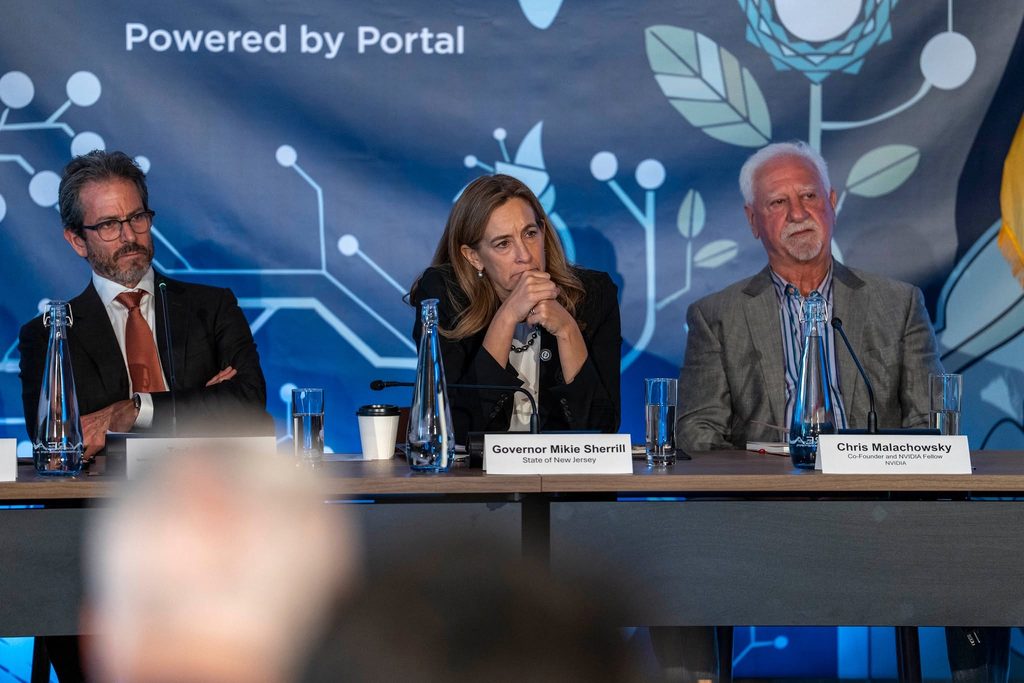
The funding includes a $75 million personal gift from NVIDIA co-founder Chris Malachowsky and his wife, Melody. The initiative also includes a $25 million statewide partnership with NVIDIA.
Public-Private Initiative
In addition to the $75 million personal gift from Chris and Melody Malachowsky, the initiative received $25 million from Somerset County IT company SHI International. SHI is working with the state and its university partners to provide the technical and strategic guidance needed to bring the initiative forward.
SHI’s work spans architecture and design, partner technology ecosystem integration, implementation, hosting, and day-to-day infrastructure operation. New Jersey is also investing $25 million through NJDEA.
“New Jersey is where my story began, and it means a great deal to give back to the community that raised me. I am grateful to Governor Sherrill and our partners across the state for making this a reality,” Malachowsky said.
“Through the New Jersey Supercomputer Initiative, we can unlock the talent that exists all around us, transform schools, businesses, and the workforce, and together, tackle our most pressing challenges,” Malachowsky said.

Common Goals
“New Jersey is positioned to show what’s possible when government, higher education and industry come together around a shared goal,” said Thai Lee, President and CEO of SHI International. “SHI is proud to support an initiative that reflects the power of public-private partnership, bringing together the expertise and technology needed to help address real challenges facing our communities. By expanding access to advanced AI resources, this initiative is designed to give New Jersey the capacity to accelerate research, strengthen education and drive innovation. We’re pleased to stand alongside the state and its leading institutions in an effort that will help shape how New Jersey competes and leads for years to come.”
NJSCI, an independent nonprofit organization, will administer the supercomputer starting in 2027 and guide it with principles including transparent governance and equitable access. As part of the Sherrill Administration’s whole-of-government approach, several agencies, including the New Jersey Innovation Authority, the New Jersey Economic Development Authority, the New Jersey Department of Labor and Workforce Development, and the New Jersey Office of the Secretary of Higher Education, are supporting this effort.
“NJSCI will ensure that the transformative capabilities of new technology are readily available to New Jersey’s leading innovators and are put to work for the benefit of all New Jerseyans,” said Dave Cole, New Jersey State Chief Innovation Officer. “This initiative brings public and private partners together to ensure New Jersey has the capacity we need to solve the complex challenges of the 21st century.”
“From advanced manufacturing to biotech, to the life sciences and artificial intelligence, Governor Sherrill is ensuring that companies in high-growth industries aren’t locked out of the resources they need to make discoveries and expand in the Garden State,” said NJEDA Chief Executive Officer Evan Weiss. “The AI Supercomputer initiative exemplifies the impact of partnerships between government, academia, and the private sector in driving innovation, and the breakthroughs made in New Jersey through this plan will advance economic opportunity and startup creation.”
“Strategic partnerships like this are how we create real economic opportunity — connecting New Jersey workers to good-paying jobs while keeping our businesses competitive,” said Kevin D. Jarvis, Acting Commissioner of the NJDOL. “The apprenticeships and training programs tied to this initiative will help New Jersey workers develop the skills needed to succeed in AI, data science, and advanced computing fields where employers are actively hiring.”
“Technology is moving at an exponential pace. New Jersey’s supercomputer initiative opens new possibilities for our institutions of higher education to advance meaningful research, prepare students for the jobs of tomorrow, and translate innovation into real-world solutions,” said Margo Chaly, New Jersey Secretary of Higher Education. “Expanding access to advanced computing and research opportunities empowers our students to be leaders of an innovative future with the high-quality education they’ve obtained right here in the Garden State.”
The Future of Supercomputers
New Jersey is reviewing dozens of projects for potential supercomputer use in 2027, including those that leverage high-performance computing and artificial intelligence to model flooding and protect coastal communities, detect and treat cancer and other diseases earlier, accelerate drug development, and improve the safety of large language models.
The state is also focusing on translating these capabilities into broader opportunities for New Jersey residents. As part of this effort, the AI Higher Education and Workforce Collaborative is working across the state’s colleges and universities to strengthen education and workforce pathways. This includes developing new curricula, hands-on training programs, and apprenticeship pathways ranging from AI literacy and responsible use to advanced computing, data science, and related disciplines. Students will gain direct experience with cutting-edge computing infrastructure through their research projects, capstones, and coursework, while developing skills that employers are actively seeking.
The supercomputer infrastructure will be hosted and operated by SHI in its existing New Jersey facilities and the NJSCI will bring new clean energy onto New Jersey’s grid, in line with the Sherrill Administration’s overall commitment to energy affordability and sustainability. To learn more about the New Jersey Supercomputer Initiative, visit NJSupercomputer.org, where additional information will be posted as it becomes available.
“We are proud to help bring this extraordinary vision to life alongside partners who share our ambition for New Jersey’s future,” said Liat Krawczyk, Executive Director of the NJ AI Hub. “This investment is about much more than computing power. It democratizes access to the tools of scientific discovery, enabling researchers and entrepreneurs to tackle problems once beyond their reach and creating new pathways for students and workers to participate in the AI economy. Together, we are building the foundations for a future in which breakthrough innovation and economic opportunity reinforce one another.”
