

New Jersey’s statewide minimum wage will increase by $0.43 to $15.92 per hour for most employees, effective Jan. 1, 2026.
Under the law, the minimum wage rate for employees of seasonal and small employers will continue to increase gradually until 2028 to lessen the impact on those businesses. The minimum hourly wage for these employees will increase to $15.23 on Jan. 1, up from $14.53.
When Murphy took office in 2018, the state’s minimum wage was $8.60 per hour, and increasing the minimum wage was quickly identified as a legislative priority. Murphy signed legislation in February 2019, that resulted in the gradual increase of the State’s minimum hourly wage to $15.13 on Jan. 1, 2024, for most employees.
“Eight years ago, Governor Murphy pledged a stronger, fairer economy, and we’re delivering on this commitment by raising New Jersey’s minimum wage again,” said Labor Commissioner Robert Asaro-Angelo. “This increase will provide vital support to all Garden State workers by making the dream of a livable wage reality.”
Farm and Agricultural Workers
Agricultural workers are guided by a separate minimum wage timetable under the law and their minimum wage rate will continue to increase incrementally until 2030.
Employees who work on a farm for an hourly or piece-rate wage will see their minimum hourly wage increase to $14.20, up from $13.40. Additionally, long-term care facility direct care staff will see their minimum hourly wage rise by $0.43, to $18.92.
Once the annual statutory increases in the minimum wage rate are completed for employees of small and seasonal employers (in 2028) and those who work on a farm for an hourly or piece-rate wage (in 2030), those minimum hourly wage rates will continue to increase annually, along with the minimum hourly wage rate for other employees.
Tipped Workers
The minimum cash wage rate for tipped workers will rise to $6.05 an hour from $5.62, with the maximum tip credit employers are able to claim remaining at $9.87.
If the minimum cash wage plus an employee’s tips do not equal at least the state minimum wage, then the employer must pay the employee the difference.
Adjusted According to CPI
The New Jersey Department of Labor and Workforce Development (NJDOL) sets the minimum wage for the coming year based on any increase in Consumer Price Index (CPI) data provided by the U.S. Bureau of Labor Statistics. This is pursuant to Article 1, Paragraph 23, of the New Jersey Constitution, and N.J.A.C. 12: 56-3.1(c).
For more on the rights and protections of tipped workers, click here. For more information on the state minimum wage, click here.
Minimum Wage Across the Country
Currently, 34 states, territories and districts have minimum wages above the federal minimum wage of $7.25 per hour.
Five states have not adopted a state minimum wage: Alabama, Louisiana, Mississippi, South Carolina and Tennessee. Three states, Georgia, Oklahoma and Wyoming, have a minimum wage below $7.25 per hour. In all eight of these states, the federal minimum wage of $7.25 per hour generally applies.
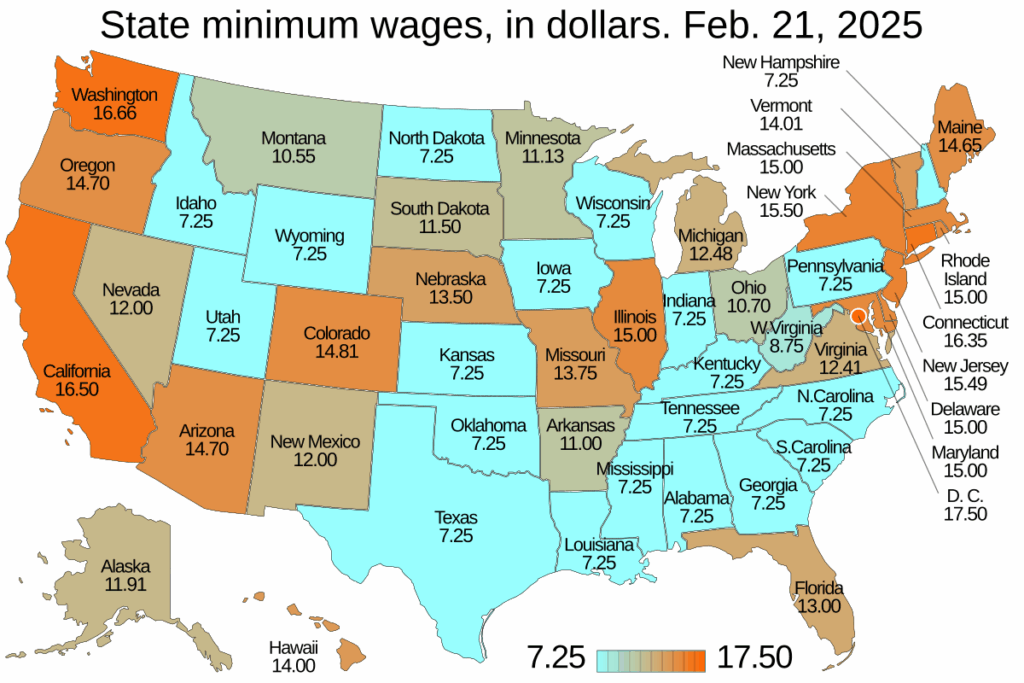
As of Jan.1, the following states are increasing minimum wages as follows:
$Arizona will increase its minimum from $14.70 in 2025 to $15.15.
$California’s floor moves from $16.50 to $16.90.
$Colorado plans a rise from $14.81 to $15.16.
$Connecticut’s minimum will go from $16.35 to $16.94.
$Hawaii is scheduled to jump from $14.00 to $16.00.
$Maine will see its rate rise from $14.65 to $15.10.
$Michigan’s minimum climbs from $12.48 to $13.73.
$Minnesota’s rate increases from $11.13 to $11.41.
$Missouri will move from $13.75 to $15.00 on.
$Montana’s rate edges up from $10.55 to $10.85.
$New Jersey will go from $14.53 to $15.23.
$New York’s minimum increases from $15.50 to $16.50.
$Ohio’s rate rises from $10.70 to $11.00.
$Oregon is raising its minimum, but the 2026 rate is not yet determined. Start date is July 1, 2026.
$Rhode Island will increase from $15.00 to $16.00.
$Vermont’s minimum goes from $14.01 to $14.42.
$Virginia will rise from $12.41 to $12.77.
$Washington’s minimum increases from $16.66 to $17.13.