

A New Jersey Senate Bill to ban non-disclosure agreements (NDAs) in data center development projects, passed last month, was referred to the Assembly’s Science, Innovation and Technology Committee.
The bill declares secrecy agreements intended to hide data center development details between applicants, sellers, or approving municipal agencies to be against public policy and unenforceable. Applicants must certify that no such agreements exist or risk losing site plan and subdivision approvals.
Senate Bill 4304, sponsored by Sen. Linda Greenstein (D-14) and Sen. Brian P. Stack (D-33), passed 38-0 with two abstentions. It would prohibit NDAs intended to conceal certain information about data center development under the Municipal Land Use Law (MLUL).
Data Center Regulation
New Jersey regulates data center development under the MLUL through strict state-level oversight, non-disclosure bans, and utility rules, according to the state legislature.
Read more: NJ Gov. Sherrill Launches Plan to Address Impact of Data Centers on Electric Costs
According to the Data Center Tracker, the following types of data centers are being developed for artificial intelligence:
- Enterprise Data Centers — Facilities built and operated by companies for their own use. Typically located on company premises and serve internal business operations.
- Colocation Data Centers — Facilities where multiple organizations rent space to house their servers and computing equipment. The facility provides power, cooling, and physical security while clients maintain their own hardware.
- Cloud / Hyperscale Data Centers — Massive facilities operated by major cloud providers (e.g. Amazon, Google, Microsoft) that deliver computing resources over the internet. This is the largest type of data center, and facilities can span millions of square feet and contain tens of thousands of servers.
- Edge Data Centers — Smaller facilities located closer to end users to reduce latency and improve performance for applications requiring real-time processing.
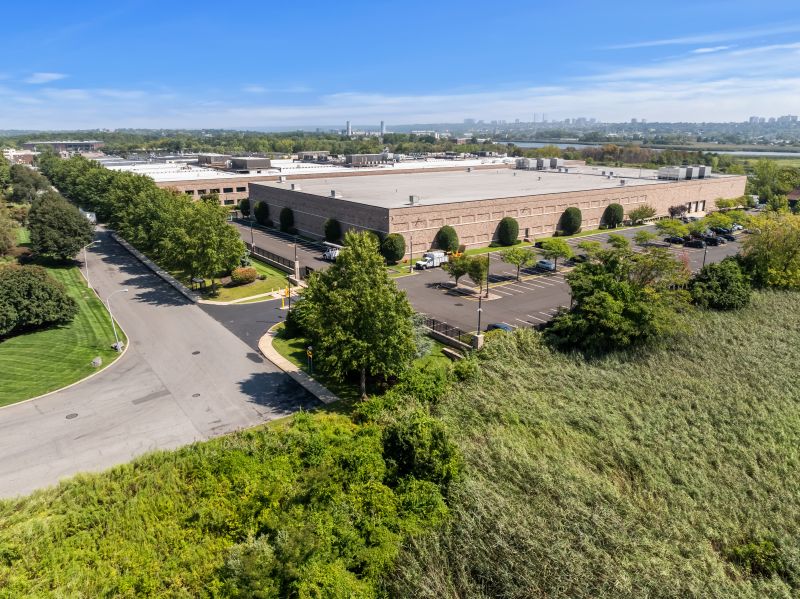
The former JPMorgan data center owned by Russo Development, 600 Commerce Blvd., Carlstadt, New Jersey, was leased to one tenant in March.
The Data Center Tracker is a citizen-run website that “tracks and visualizes proposed data center projects and development activity across multiple states, aggregating public records, company announcements, and local news into a single searchable database. Unlike other trackers, it focuses on mapping known and approximate site boundaries and physical footprints.”
Data Centers in the Meadowlands
New Jersey hosts over 80 active facilities, with a major concentration in the Greater Meadowlands area—including multiple sites across Secaucus, Hackensack, Carlstadt, and Clifton. At least 13 existing data center facilities are in the core Meadowlands region, including Secaucus, Carlstadt, and North Bergen.
The Equinix data center facility in Secaucus, New Jersey, near Hartz Way and Meadowlands Parkway, recently made headlines after experiencing a mechanical failure involving two filtration process valves. According to the township of Secaucus website, approximately 5,000 gallons of diesel fuel leaked from an outside storage tank into an unnamed tributary near Anderson Creek.
Regulation and Reporting
Under legislation (S3379/A4096) signed by N.J. Gov. Mikie Sherrill on Aug. 27, every data center in the state must report its water and energy usage to the New Jersey Board of Public Utilities (BPU) every six months. The BPU will make the information publicly available on its website, including service agreement details, according to the NJEDA.
Each report must identify the facility, its owner or operator, its address, and when it commenced operation. The report must also detail total energy consumption, total and peak daily water input, and all water sources.
“Data centers are among the biggest drivers of energy costs, which I am working tirelessly to bring down. While many states are approaching this issue piecemeal, this is the first comprehensive plan to tackle it holistically. At the same time, New Jersey will take a thoughtful approach to harnessing investment, lowering costs for ratepayers, and leading on AI innovation,” Sherrill said in August.
“By establishing these guardrails, we will hold data centers accountable, ensure they contribute their fair share, and make sure our communities not only benefit from the AI innovation happening in our state, but have a real hand in shaping it,” the governor added.
